




Optimizing GPC performance: Multi-Angle Static Light Scattering detection using the BI-MwA

Summary
Gel-permeation chromatography (GPC) coupled with Multi-Angle Static Light Scattering (SLS) is a modern and powerful technique for determining absolute molecular weight values without the need to rely on traditional column calibration. In GPC- MALS, the signal intensity levels are evaluated quantitatively rather than by elution times. Furthermore, unlike polymer standard calibration, details of the accurate sample concentration, injection volume and corresponding mass are required for accurate interpretation of light scattering signals.
Introduction
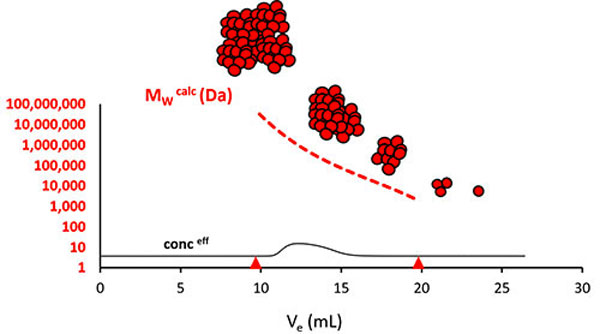
GPC is a useful technique for the determination of molecular weights of proteins, polymers, and many other nanomaterials. However, its usefulness is limited by the requirement for calibration of the GPC columns with standards of known molecular weight (Mw) which may not be of the same chemistry as the unknown sample. The mechanism of separation is fundamentally hydrodynamic and based on size-exclusion. Depending on the eluent, it is then possible that certain samples might adhere to the stationary phase during elution, yielding erroneous molecular weight determinations. A better approach is to equip the GPC system with a multi-angle light scattering (MALS) detector, enabling accurate molecular weight determinations without the need for column calibration. The GPC fractionates the sample and the MALS detector provides absolute Mw.
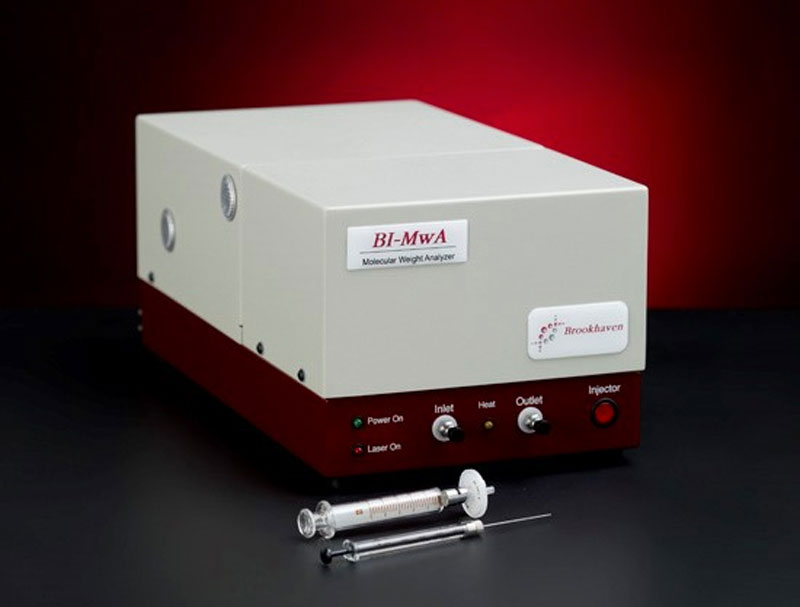
The BI-MwA is a Multi-Angle Static Light Scattering (MALS) detector, commonly coupled with the BI-DNDC (a differential refractometer) when bundled with a GPC system. Fiber optic coupling to the interior flow cell allows for 7 fixed detection angles, allowing for angular dependence of scattered light to be obtained. A typical GPC experiment using this detector configuration would produce a chromatogram with up to three traces: UV, RI, and LS. The first, UV, is often inadequate to detect synthetic polymers which, in contrast to protein samples, often have minimal, or no, UV absorbance. The LS trace can be expanded to show static intensity from each angle separately.
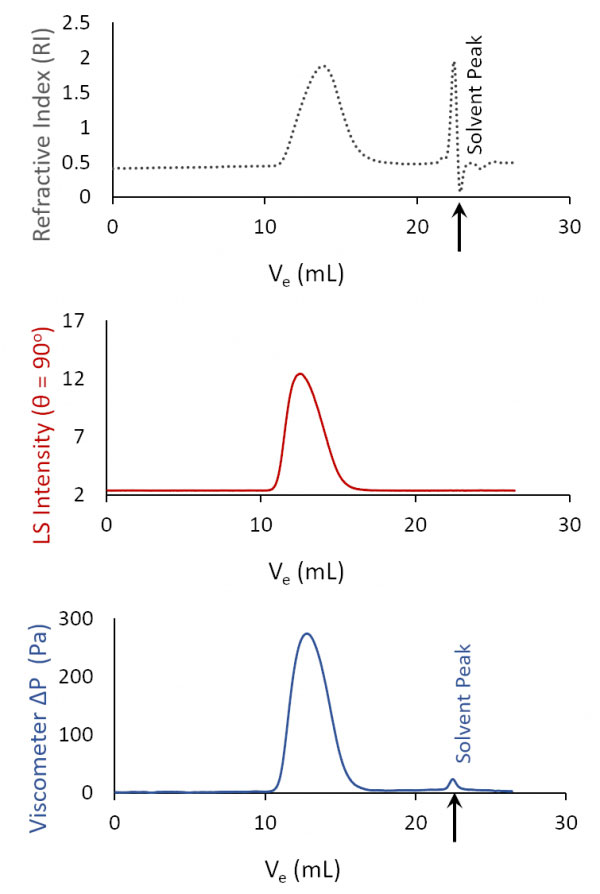
Very simple GPC systems are composed of a single column, injector, pump, and detector, with no other accessories. High-end HPLC systems may come with multiple detectors, autosamplers, column ovens and more. In either case, the most important components will be the GPC column itself and the detector. The BIMwA can acquire the analog output from a variety of detectors that may already be part of an existing GPC system to provide additional detection capabilities such as viscosity, UV, and RI. This data can be read into the ParSEC Size Exclusion Chromatography acquisition software, to produce a unified chromatogram. These inputs can be combined to calculate either an instantaneous molecular weight at any point in the chromatogram, or an average molecular weight over a preselected range.
Experimental setup
Analysis
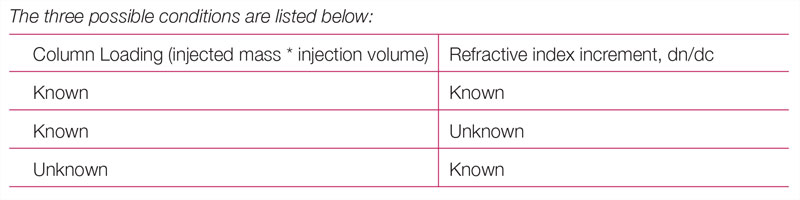
There are three choices for analyzing obtained data. These choices can be organized according to what is known about the sample. There are two possible parameters about an unknown that may be known in advance, specifically, the injected mass and the sample dn/dc.
Results
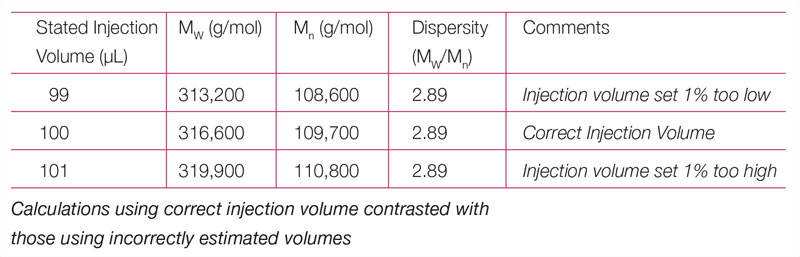
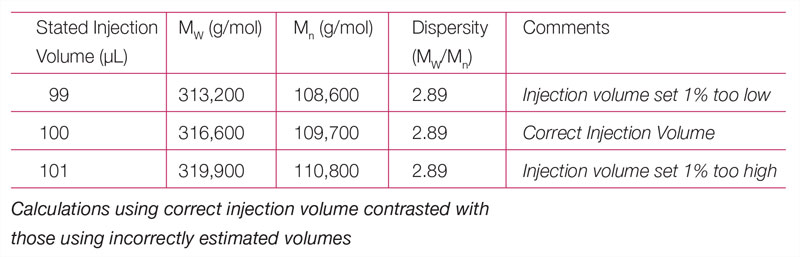
We have demonstrated the importance of accurately determining the on-column concentration of the injected sample. As shown below, the apparent molecular weight, Mw, differs dramatically when even minor discrepancies are introduced in injection volume.
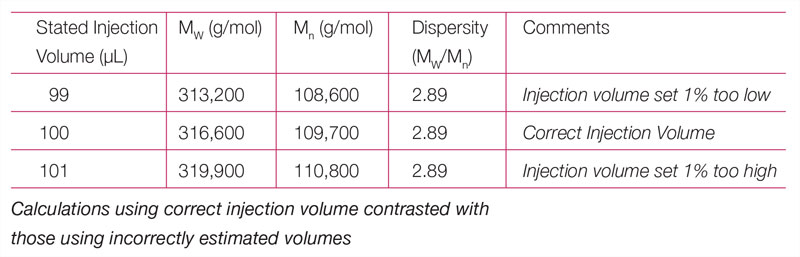
An example of the effects of injection volume variation is shown in the above table. Data were collected with ParSEC software and analyzed in three ways. Analysis was performed for the case where concentration is known, and dn/dc is unknown. Note that the determined molecular weight has also changed by about 5%. This illustrates the impact of varying the injection volume.
In typical operation, ParSEC software calculates absolute concentration and molecular weight as a function of elution volume by generating partial Zimm plots based on the Zimm equation and extrapolating the light scattering data to zero angle. Naturally, extrapolation to zero concentration is impossible since concentration dependent data is unavailable. But, like all modern GPC/SEC software, ParSEC allows a correction for the second virial coefficient.
Conclusions
The BIMwA is a powerful tool that can dramatically increase the capability of an existing GPC system. Reproducible column loading is critical for successfully coupling multi-angle static light scattering (MALS) with GPC, SEC, or any other chromatographic technique. This is necessary since concentration is an essential variable in the Zimm equation (see appendix), which is itself the basis of calculating molecular weight.
• Choice of Analysis Method. If the injector repeatability is no better than 2%, analyzing samples with an unknown injected mass (concentration and injection volume) and a known dn/dc value is preferred over other methods.
• Injector Performance Target. When analyzing samples with unknown values of dn/dc (the most common case), injector repeatability should be better than 1%. This specification is readily met.
• Sample Concentration Performance Target. When analyzing samples with unknown values of dn/dc (the most common case), sample concentration should be accurate to better than 1%. This specification is easy to meet.
Appendix
Light Scattering Calculations
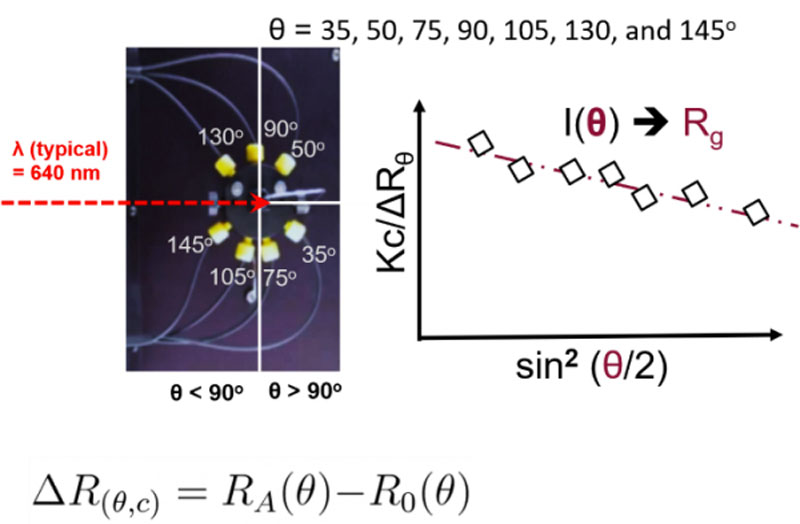
When calculating Molecular Weight, light scattering data is typically evaluated using the Zimm equation:
Here, K is the Debye constant, a constant of the polymer-solvent or protein-solvent system. For vertically polarized light,
where n is the solvent refractive index, Na is Avogadro’s number, and λ is the wavelength of the laser. Polymer or protein concentration, c, is determined when sample solutions are prepared, and ΔR is proportional to the excess scattered intensity and measured.
Applications: BiopharmaMolecular WeightPolymersHPLCSECGPCFlow-Mode
Instruments: BI-DNDCBI-MwA
Thank You!
Your message has been forwarded to our team and we will reply as soon as possible. Thank you for your patience.
© 2026 TESTA Analytical Solutions e.K. All rights reserved.